// Documentation Guide
Cumulative Delta
Understand how QUANTIX tracks net aggressive buying versus selling and how to use CVD in execution decisions.
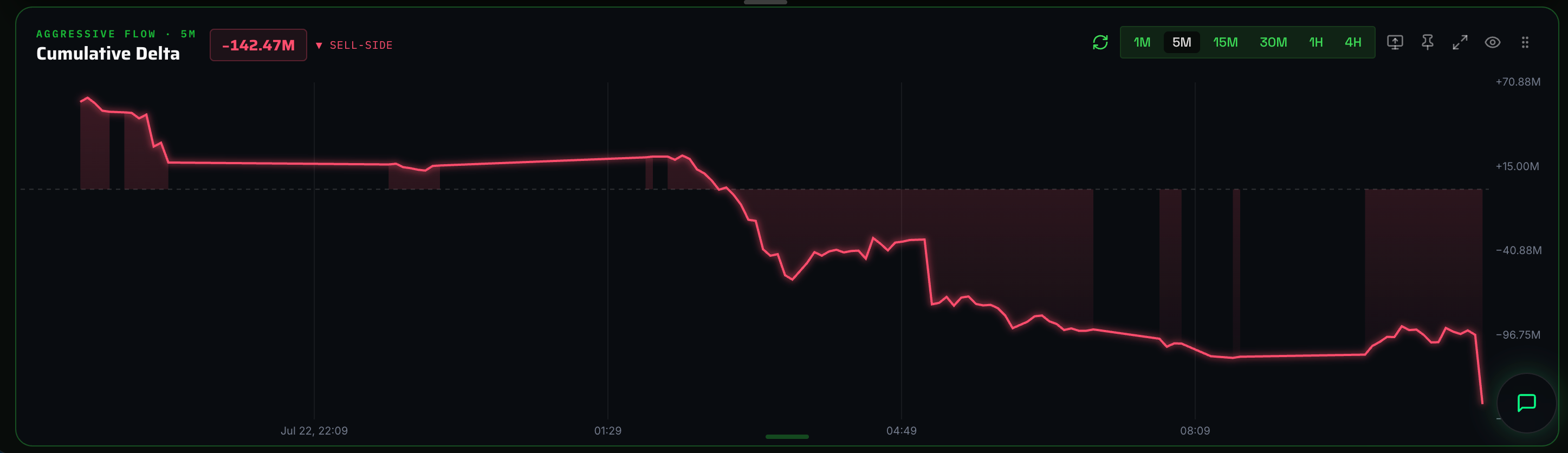
Overview
CVD measures the net difference between aggressive market buys and aggressive market sells over time.
In QUANTIX, the panel functions as a high-speed execution tool:
Volumemode accumulates signed traded volume.Tradesmode accumulates signed trade count.- The chart updates directly from the live
cvdstream and backfills historical data on demand.
Use it to answer a critical execution question:
Is aggressive flow confirming price, diverging from price, or being absorbed?
What it shows
- Rising CVD: Buyers are aggressively lifting the ask.
- Falling CVD: Sellers are aggressively hitting the bid.
- Price up + CVD flat/down: Weak rally or absorption into passive sellers.
- Price down + CVD flat/up: Weak selloff or absorption into passive buyers.
Data source
CVD is calculated exclusively from executed Taker (aggressive) orders. The side of the aggressor determines the delta sign:
- Taker Buy (hitting the ask) adds positive delta.
- Taker Sell (hitting the bid) adds negative delta.
Data flows through the QUANTIX high-performance pipeline:
- Ingestion: Raw trades are captured directly from exchange websockets.
- Aggregation: The backend
CVDManagergroups micro-trades to optimize frontend rendering without sacrificing volume precision. - Live Stream & Backfill: The widget renders live flow instantly via websocket while concurrently fetching historical context from ClickHouse.
This architecture delivers millisecond-latency aggressive flow updates while maintaining accurate historical context.
Practical use
Trend confirmation
When price and CVD move in the same direction, aggressive flow validates the trend.
- Price up + CVD up: Healthy buying pressure.
- Price down + CVD down: Healthy selling pressure.
Divergence
When price achieves a new structural extreme but CVD fails to confirm it, participation is dropping.
- Bullish divergence: Price makes a lower low; CVD makes a higher low.
- Bearish divergence: Price makes a higher high; CVD makes a lower high.
Absorption
Absorption occurs when aggressive orders execute continuously, but price fails to progress.
- Strong positive delta into resistance, but price stalls.
- Strong negative delta into support, but price holds.
This indicates massive passive liquidity is absorbing the aggressive flow.
Best practices
- Pair
CVDwith theOrder BookorDOM Profileto confirm exactly where aggression is meeting passive liquidity. - Use higher timeframes to spot structural divergence and lower timeframes for precise execution.
- Treat sharp, parabolic CVD moves with extreme caution if price stops responding to the flow.